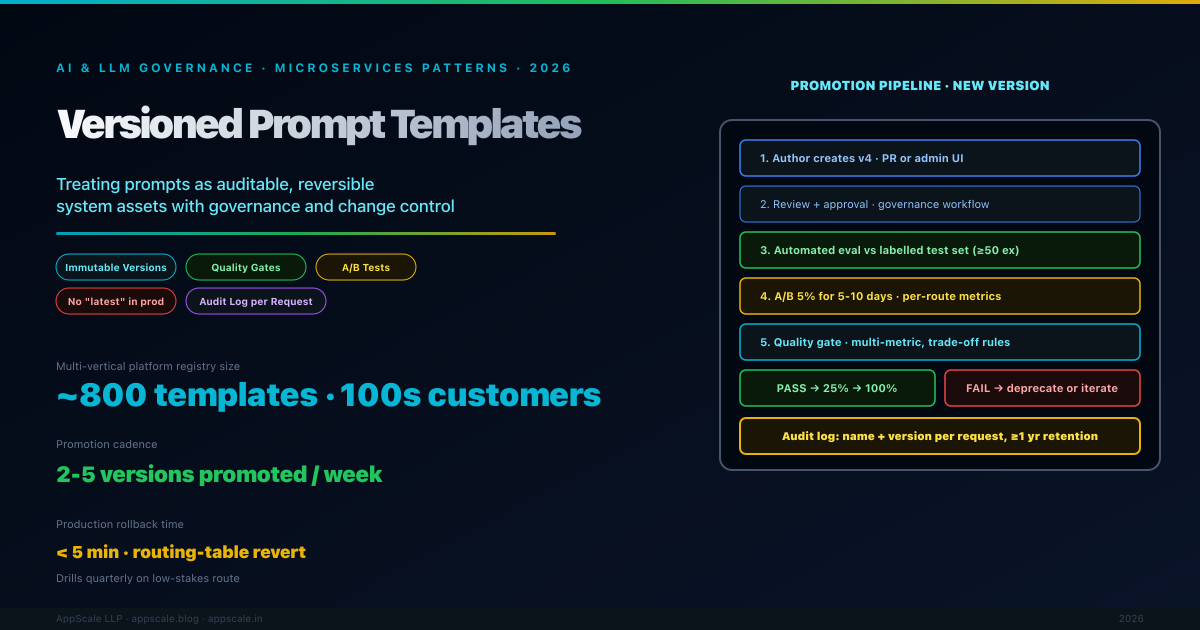
The Versioned Prompt Templates Pattern: Treating Prompts as Auditable, Reversible System Assets With Governance and Change Control (2026)


The most common AI architecture mistake of 2024 and 2025 was sending the user's raw input directly into the language model and hoping the prompt was clever enough to handle every case. The mistake produced predictable failures: medical chatbots that gave dosing advice, support bots jailbroken into discussing competitors, internal copilots that exfiltrated data because the prompt did not know what kind of question it was answering. Classification-first inserts a small fast classifier in front of the LLM whose only job is to determine intent and route the request accordingly. This article covers the foundational role of intent classification, implementation patterns (fine-tuned small models, embedding routing, LLM-as-classifier, hybrid), composition with prompt routing and per-category guardrails, anti-patterns, configuration values, and operational discipline of monitoring accuracy and drift over time.
Once an AI system has a classifier producing a category for every request, the obvious next question is: now what? The category by itself does nothing — it must drive a decision about which prompt template formats the request, which tools the model is allowed to call, which retrieval index to query, which guardrails to apply, which model variant to run, and which post-processing rules to enforce. The prompt routing pattern is the explicit, declarative mapping from category to handler bundle: each category points at a complete recipe of template + tools + guards + model + retrieval + post-processing. This article covers the role of explicit per-category bundles, implementation patterns (YAML, database registry, code-based, hybrid), composition with classification-first and versioned templates, anti-patterns, configuration values, and the operational discipline of monitoring per-route quality independently.
A single slow downstream dependency is the most common cause of complete system outages in modern microservices architectures. The circuit breaker pattern prevents the cascade by stopping calls to a failing downstream and failing fast for upstream callers. This article covers the three states (closed, open, half-open), the metrics that drive transitions (failure rate, slow-call rate, sliding windows), production-tested configuration values, the composition with bulkheads and retries, fallback strategies, and the failure modes of the breaker pattern itself — with examples from Resilience4j, Polly, and service-mesh implementations in Istio and Linkerd.
One prompt edit, shipped with no version history and no eval, silently regresses production for a week. PromptOps: prompts as versioned, tested, rollback-able code.
Advertise and partner
Reach engineering leaders and CTOs reading about AI, mobile and cloud architecture.
Sponsored mentions and co-authored articles or technical deep-dives. Relevant products only, always disclosed.