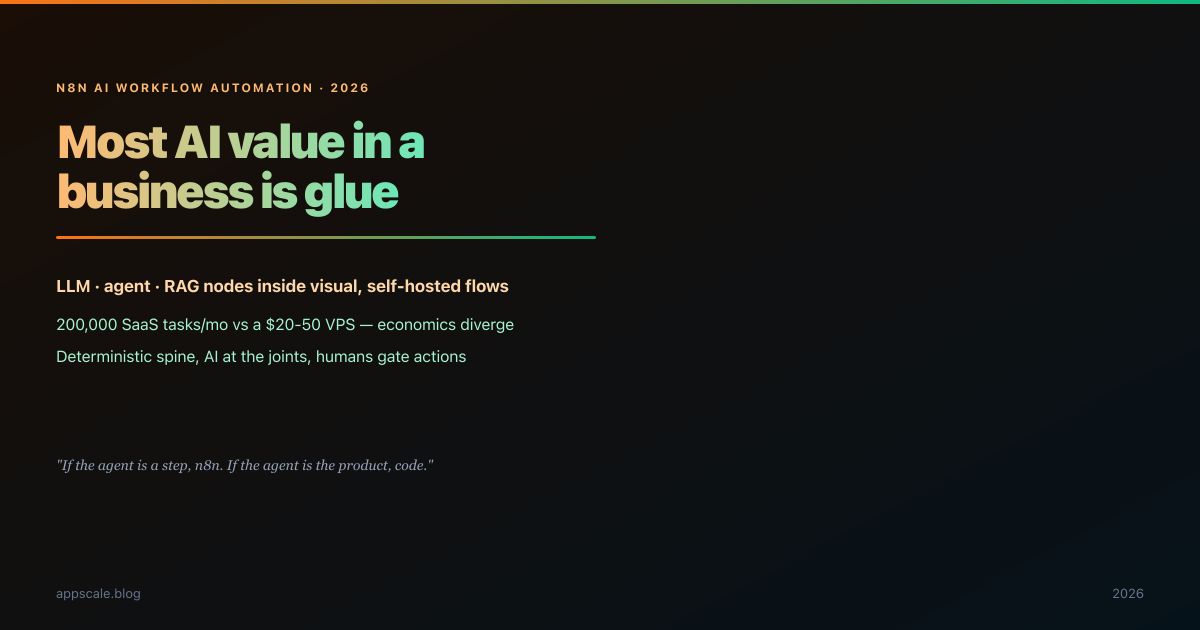
n8n AI Workflow Automation: Architecture, Agents, and When to Use It


A production-grade reference for building AI agents on AWS Bedrock with a NestJS gateway in 2026 — Bedrock AgentCore, action groups backed by Lambda, knowledge bases over S3 + OpenSearch, the routing-and-guardrail layer that NestJS must own, the model-selection cost arithmetic, three-layer observability (gateway + agent-internal + per-token cost), Bedrock Guardrails plus app-specific PII redaction, multi-agent collaboration patterns, and the failure modes you only learn about by running this in production.
A team running a customer-support assistant on GPT-4o reported a beautiful number to their CFO: 47% cache hit-rate, $18,000 per month saved, p95 latency down from 2.4s to 380ms. Three weeks later the same team was reading a customer-trust incident report. The semantic cache had decided two refund-policy questions were "the same enough" at cosine similarity 0.93 — and 0.93 had been a reasonable threshold on the eval set, which had not contained two refund policies. The cache was not broken; the cache was working exactly as designed. The architecture was wrong. This article is the deep-architecture answer to the question the team had not asked: when does semantic cache help, and when does it lie? Four-tier hierarchy from exact-key through normalised through semantic to LLM, three-step threshold calibration using a risk-weighted decision rule, multi-tenant key design that prevents the cross-tenant-pollution incident, TTL and model-version discipline, eight failure patterns to retire, five-stage maturity ladder, and the Monday-morning checklist that ships sustainable savings without the customer-trust incidents.
The Lambda-versus-Fargate question stopped being binary and became openly hybrid by 2026. Teams shipping the cleanest production architectures use Lambda for its cold-start economics on sporadic event-driven work, Fargate for its long-running container economics on sustained traffic, and route between the two intelligently. This article covers the cost-curve arithmetic that decides most choices, the AI inference workload caveats including the 2026 GPU-on-Fargate gap, the hybrid routing pattern using ALB / EventBridge / Step Functions, NestJS deployment patterns that target both runtimes from one codebase, a real cost comparison spreadsheet for a 50M-request-per-month API, and the observability discipline required to run both together.
You cannot grade an agent by its final answer. Evaluate the trajectory — tool use, safety, efficiency, robustness — and gate every change. The agent-eval architecture.
Advertise and partner
Reach engineering leaders and CTOs reading about AI, mobile and cloud architecture.
Sponsored mentions and co-authored articles or technical deep-dives. Relevant products only, always disclosed.