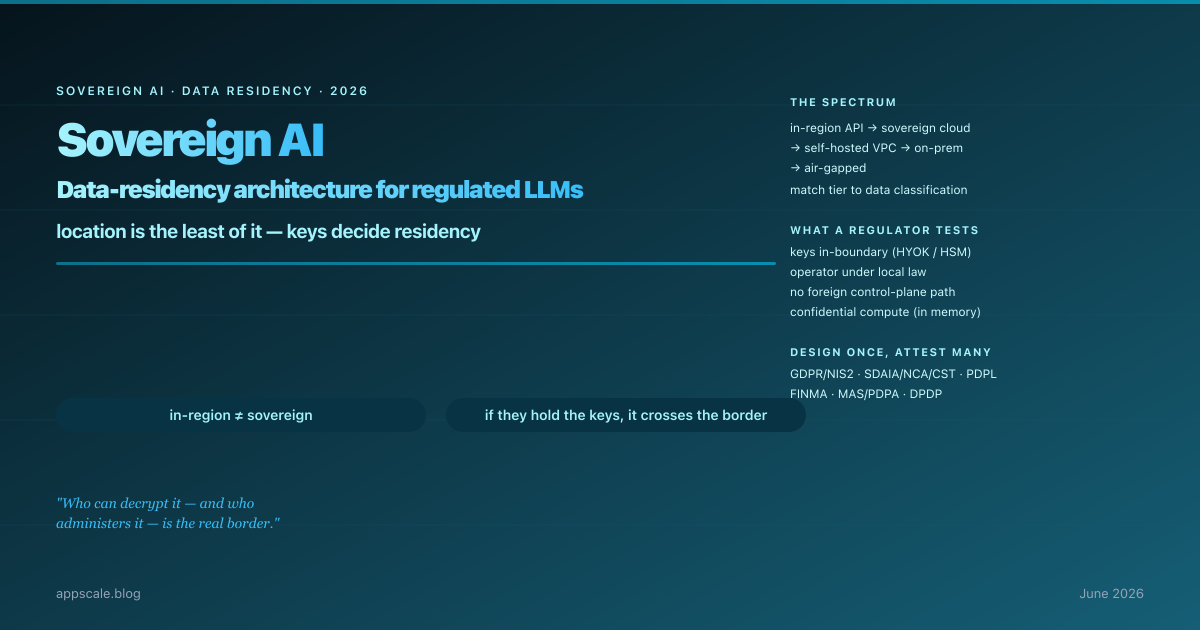
Sovereign AI: Data-Residency Architecture for Regulated, In-Border LLM Systems (2026)


A reference architecture for offline LLM systems in air-gapped environments. Covers signed update flows, local registries, offline retrieval, observability, security controls, and the real cost profile of air-gapped AI.
Building HIPAA-compliant AI systems requires more than a Business Associate Agreement. This guide covers the complete architecture: PHI de-identification and pseudonymisation layers, sensitivity-based model routing, RBAC for minimum necessary compliance, immutable audit trails, and clinical use cases — ambient scribing, decision support, and patient-facing chatbots.
Poland in 2026 is the structurally interesting answer to the where-do-we-build-AI question — the cost gap, the EU AI Act compliance moat, and the local-LLM stack converged. This is the architecture that makes the answer credible: the team topology that puts the platform and EU-customer surface in Poland with full ownership, the two-data-plane partitioning that makes EU-residency enforceable, the dual GDPR + AI Act compliance posture that pre-empts buyer due-diligence, the IP boundary that survives the US-client security audit, and the 24-hour eval cycle that turns the time-zone gap into a velocity multiplier. 8 anti-patterns, 5-stage maturity ladder, portable to Romania, Portugal, Czech Republic.
Game AI in 2026 collides hardest with frame-rate budgets, session-cost economics, and the modding community's ability to break any system without adversarial assumptions. This article walks the engineering deliverables for an LLM-driven game AI architecture in 2026: tier-routed inference (on-device 1-3B small model, edge 7-13B mid-size, cloud frontier) with budget-aware routing; state-machine-augmented dialogue with LLM-generated surface variation; procedural quest skeletons with LLM in-fill within writer-defined templates; multi-layer content-safety and prompt-injection defence; per-session cost budget as engineering discipline; semantic cache as first-class architectural element. PL-anchored to the Warsaw/Krakow game-dev cluster (CD Projekt Red, Techland, 11 bit, People Can Fly, Bloober Team) and globally portable. 8 anti-patterns, 5-stage maturity ladder.
Advertise and partner
Reach engineering leaders and CTOs reading about AI, mobile and cloud architecture.
Sponsored mentions and co-authored articles or technical deep-dives. Relevant products only, always disclosed.