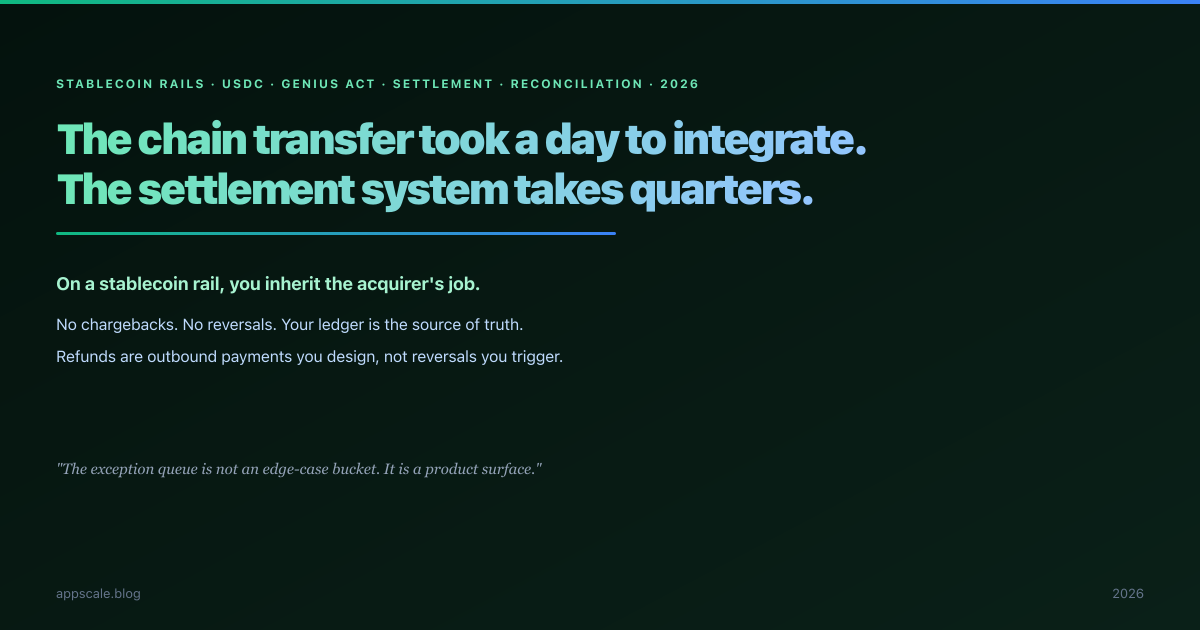
Stablecoin Payment Rails: Settlement Architecture for Real Products


The honest reason most voice AI demos feel awkward in production is latency budget. A human conversational turn-taking gap is roughly 200ms; anything beyond about 800ms feels broken; the comfortable 2026 production target is end-to-end speech-to-speech response under 500ms, measured from the user’s last audio frame to the first audio frame of the agent’s reply. The architectures that hit this in 2026 are not faster models bolted onto the same pipeline; they are streaming end-to-end with first-token TTFT optimisation, barge-in handling, jitter-tolerant transport, and a hard discipline about what runs at the edge versus the cloud. This article is the deep-architecture decision guide: the latency budget broken down stage by stage, why batch ASR plus chat-completion LLM plus offline TTS will never hit the target, OpenAI Realtime API and Gemini Live as integrated speech-to-speech baselines, Pipecat and LiveKit Agents as orchestration layers, barge-in via Silero VAD and turn-end prediction, WebRTC versus WebSocket transport, streaming TTS with ElevenLabs Flash and Cartesia Sonic, eval metrics (WER, latency p50/p99, barge-in latency, turn-taking smoothness), eight anti-patterns, five-stage maturity ladder.
Robot teleoperation fallback done right: the robot owns safety, remote operators advise rather than drive, and the operator ratio is your real business model.
The single index to 50+ production AI architecture patterns — retrieval, agents, serving, evaluation, security, cost — with decision tables and anti-patterns.
Sim-to-real transfer in 2026: the reality gap is a measurement, not a feeling. Decompose it, calibrate what you can, randomise the rest, gate on hardware.
Advertise and partner
Reach engineering leaders and CTOs reading about AI, mobile and cloud architecture.
Sponsored mentions and co-authored articles or technical deep-dives. Relevant products only, always disclosed.