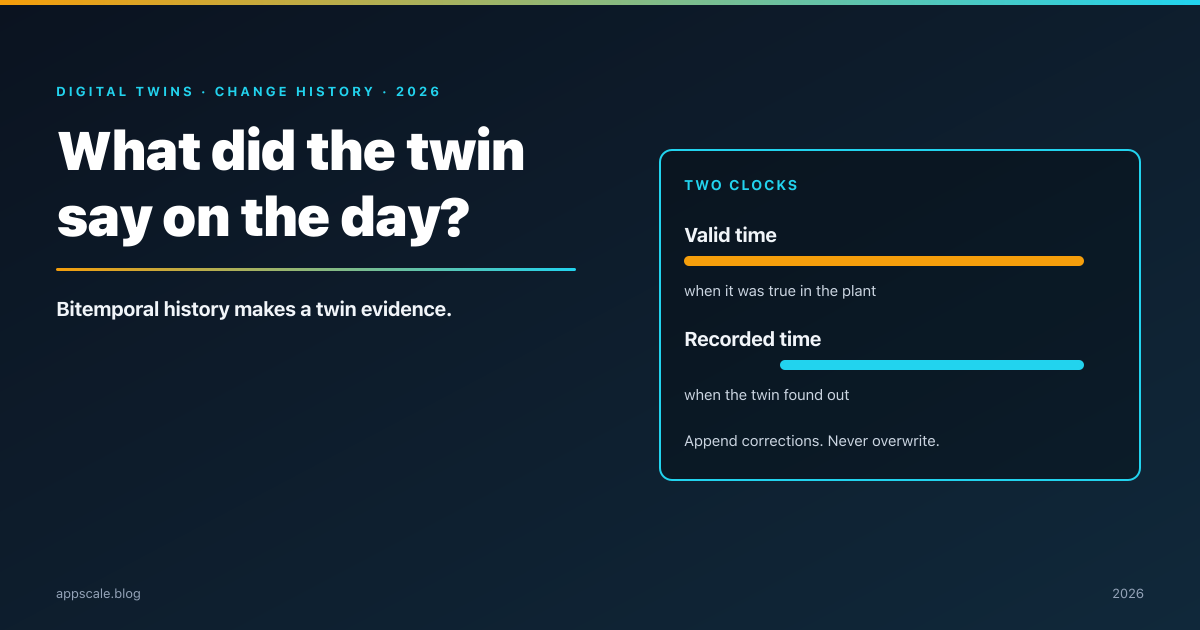
Digital Twin Versioning and Change History (2026): Bitemporal History Is What Turns a Twin Into Evidence


Sparkplug, MQTT, Kafka and the twin platform in four tiers: how sensor data should flow into Azure Digital Twins, TwinMaker or Ditto, and the staleness contract that stops lag.
The most consequential string in any production AI system is the prompt template. It controls behaviour, tone, safety, accuracy, cost, and latency. A small change can move quality up or down by ten per cent; a thoughtless edit can introduce regressions that take weeks to detect. Yet in the early demo era, prompts were typically pasted into application code as multi-line string literals, edited directly, with no review, no version history, no rollback story. The versioned prompt templates pattern fixes this by treating prompts as first-class system assets — stored in a versioned repository, referenced by explicit version IDs, deployed through review-and-rollout discipline, logged in the audit trail. This article covers immutability of published versions, implementation patterns (file-based, database-backed, managed platforms, hybrid), composition with classification-first and prompt routing, anti-patterns, configuration values, and the operational discipline of A/B testing and quality-gated promotion.
One prompt edit, shipped with no version history and no eval, silently regresses production for a week. PromptOps: prompts as versioned, tested, rollback-able code.
A judge scored 4.6/5 for months while users churned over wrong answers. When to use LLM-as-a-judge, when deterministic checks win, and the calibration that separates them.
Advertise and partner
Reach engineering leaders and CTOs reading about AI, mobile and cloud architecture.
Sponsored mentions and co-authored articles or technical deep-dives. Relevant products only, always disclosed.