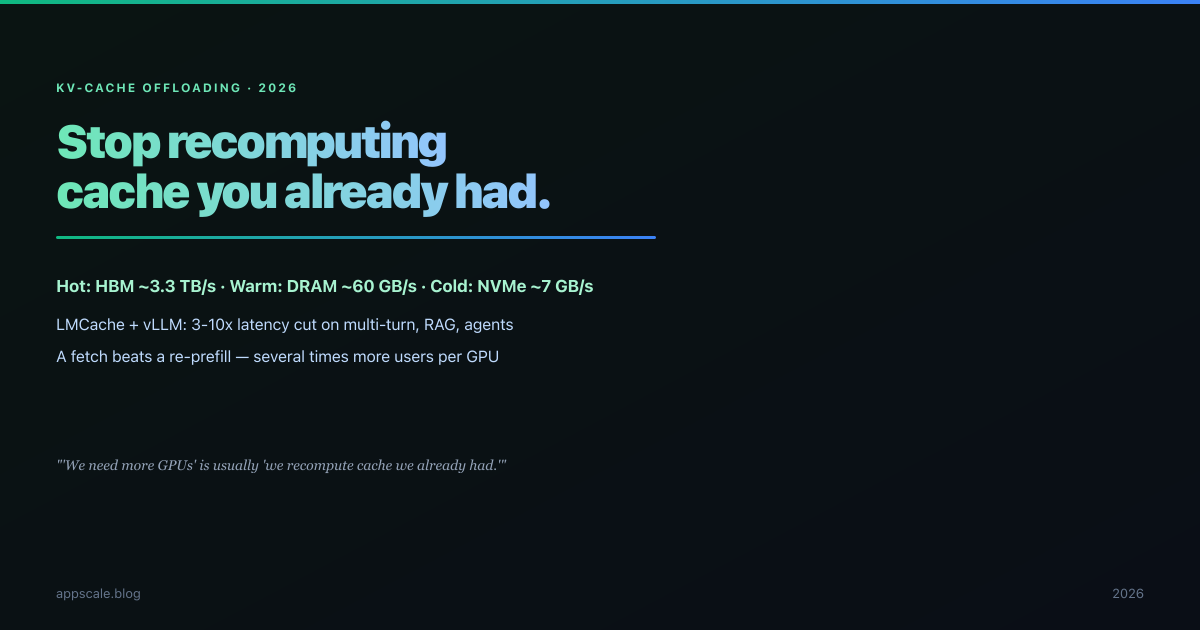
KV-Cache Offloading: Serving 10x More Users by Not Recomputing


The single biggest determinant of whether an LLM feature is economically viable in production is not which model you chose — it is how the KV-cache is managed across the serving stack. This article is a practitioner reference for KV-cache engineering in 2026: paged attention as baseline, prefix caching for RAG hit rates of 70-85%, prefill-decode disaggregation for high-throughput deployments, and three 2026 production case studies (Gemma 4 cross-layer KV sharing in vLLM, Laguna XS.2 non-uniform tensor parallelism, DeepSeek V4 CSA+HCA reducing 1M-context cache by 90%). The compounding effect of the full stack: $1.39 → $0.07 per million tokens on the same physical hardware.
Your GPU bill soars while the GPUs sit ~95% idle. It’s a utilization problem, not a capacity one — continuous batching, scale-to-zero, fractional GPU, and the demand-side fix.
Your GPU sits idle generating tokens because decode is memory-bound. Why HBM bandwidth in TB/s, not peak FLOPs, decides your inference serving architecture.
A quarter of your datacenter DRAM is stranded behind cores already sold. CXL memory pooling reclaims it — for the latency-tolerant workloads that actually fit.
Advertise and partner
Reach engineering leaders and CTOs reading about AI, mobile and cloud architecture.
Sponsored mentions and co-authored articles or technical deep-dives. Relevant products only, always disclosed.