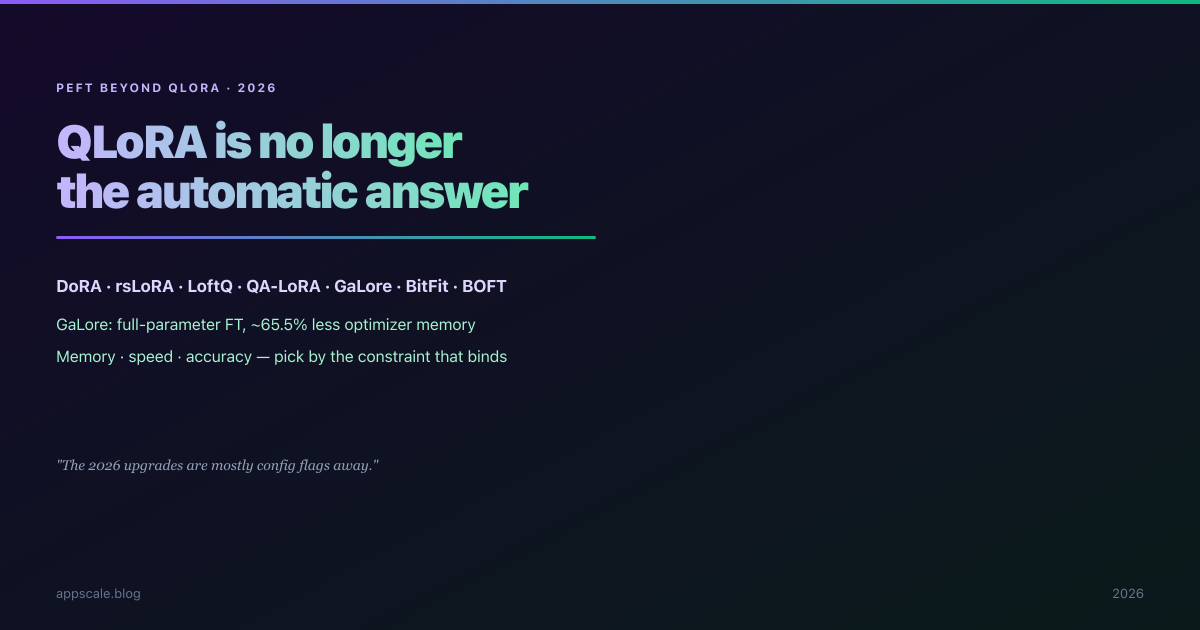
Parameter-Efficient Fine-Tuning (PEFT) Beyond QLoRA: DoRA, GaLore, and LoftQ


Fine-tuning is the production capability most teams underestimate. With a few thousand high-quality examples and a single GPU, a 7 to 14B open-weights model can match or exceed a frontier model on the target task at one to two orders of magnitude lower cost. This guide compares full fine-tuning, LoRA, QLoRA, and DoRA — when each is the right choice, the hardware and dataset requirements, the hyperparameters that matter, the evaluation discipline, and the deployment patterns (merged weights, multi-LoRA serving, hot-swap adapters) that turn one base model into many specialised production endpoints.
Fine-tuning, RAG, and prompt engineering answer three different questions — how should it behave, what should it know, what should it be told. A decision architecture.
A comprehensive guide to context engineering — the architectural discipline of designing systems that assemble the right information into an LLM's context window for every request. Covers the five types of context, the four-layer architecture stack, five production patterns, context window architecture for million-token models, agent context management, quality metrics, cost architecture, and three forward-looking trends.
Partitioning makes one box manageable; sharding makes many boxes act as one database. The decision table, shard-key design, and the scaling ladder to exhaust first.
Advertise and partner
Reach engineering leaders and CTOs reading about AI, mobile and cloud architecture.
Sponsored mentions and co-authored articles or technical deep-dives. Relevant products only, always disclosed.